Introduction
For decades, relaxor ferroelectrics have quietly powered some of the most essential technologies in modern life—from medical ultrasound scanners to military sonar systems. Yet, despite their widespread use, the precise arrangement of atoms and electric charges within these materials remained a stubborn mystery. That mystery has now been solved. Researchers at MIT have, for the first time, mapped the three-dimensional atomic structure of a relaxor ferroelectric with extraordinary detail, revealing hidden patterns in how electric charges are organized at the nanoscale. This breakthrough not only overturns long-held assumptions about how these materials behave but also gives scientists the tools to refine design models for next-generation devices.
The Mystery of Relaxor Ferroelectrics
Relaxor ferroelectrics belong to a class of materials that exhibit exceptional piezoelectric and electrostrictive properties—meaning they change shape when an electric field is applied. This makes them invaluable for precision actuators, sensors, and imaging equipment. But unlike conventional ferroelectrics, relaxors display a diffuse phase transition and a highly disordered arrangement of polar nanoregions (PNRs). For years, scientists could only infer the likely structure of these PNRs from indirect measurements, leading to conflicting theories about their size, orientation, and interaction.
The core challenge was that the nanoscale features responsible for the material’s extraordinary performance are just a few atoms wide, making them invisible to traditional imaging techniques. Without a clear picture of the atomic arrangement, engineers had to rely on trial-and-error methods to optimize these materials, slowing innovation in fields that depend on their unique capabilities.
Breakthrough: Imaging the Atomic Lattice
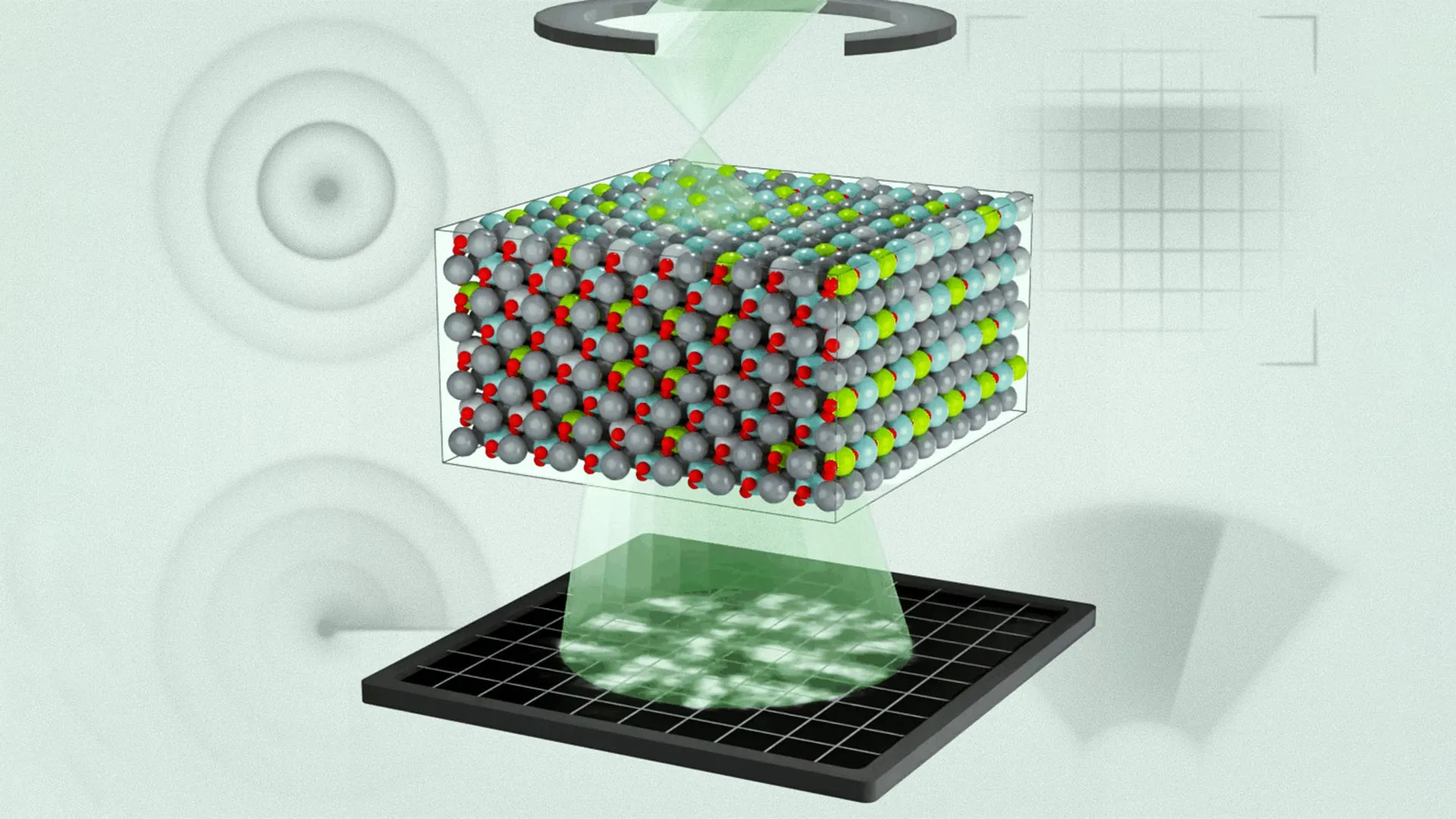
The MIT team employed a sophisticated combination of scanning transmission electron microscopy (STEM) and advanced computational algorithms to reconstruct the three-dimensional arrangement of atoms in a sample of a prototypical relaxor ferroelectric. By analyzing thousands of two-dimensional images taken from different angles, they built a detailed 3D map showing the positions of lead, oxygen, and titanium atoms, as well as the subtle shifts that create local electric dipoles.
What they discovered was unexpected. Instead of randomly scattered polar regions, the researchers found a hierarchical structure: small, highly polar clusters nested within larger, less ordered regions. These nanodomains are not static but fluctuate in size and orientation, giving the material its characteristic “relaxor” behavior. The data revealed that the local electric fields generated by these clusters interact in ways that were previously unaccounted for in theoretical models.
Implications for Materials Science and Technology
This atomic-level understanding has immediate and far-reaching consequences. First, it validates some earlier hypotheses while disproving others. For example, the notion that PNRs are randomly oriented is now replaced by a more nuanced picture of correlated clusters that exhibit short-range order. Second, the new structural data allow researchers to create more accurate computer simulations of relaxor behavior. Engineers can now predict how a specific composition or processing condition will affect performance, reducing the need for costly experimental iterations.
Practical applications could range from higher-resolution ultrasound imaging to more sensitive sonar arrays and more efficient energy-harvesting devices. The material’s ability to convert mechanical stress into electrical signals (and vice versa) could be fine-tuned for better medical diagnostics, non-destructive testing, and even next-generation robotics.
Refining Design Models
One of the most exciting outcomes of this discovery is the potential to revisit decades of theoretical work. The MIT team has already started using the experimental 3D map to benchmark existing models. They found that many continuum-level theories underestimate the role of local electric field inhomogeneities. By incorporating the newly observed nanoscale correlations, scientists can develop improved phase-field and density functional theory models. These refined models will guide the synthesis of new relaxor compositions with enhanced properties, such as higher piezoelectric coefficients or better temperature stability.
Future Directions and Open Questions
While the MIT study focused on a single composition (lead magnesium niobate-lead titanate, PMN-PT), the methodology can be extended to other relaxor systems. Researchers are now eager to apply the same 3D imaging technique to lead-free alternatives and high-entropy relaxors. Additionally, the dynamic nature of the nanodomains raises intriguing questions about how they respond to external stimuli such as electric fields, temperature changes, and mechanical stress. Time-resolved experiments could reveal how the structure evolves in real time during device operation.
The team also plans to make their 3D atomic maps publicly available, fostering collaboration across the materials science community. As one MIT researcher noted, “For the first time, we have a complete picture of the nanoscale architecture that makes relaxors so special. Now the real work begins—turning this knowledge into better devices.”
Conclusion
The MIT scientists’ achievement marks a turning point in the study of complex functional materials. By finally pulling back the curtain on the hidden atomic structure of relaxor ferroelectrics, they have not only satisfied a long-standing scientific curiosity but also laid the groundwork for technological leaps in imaging, sensing, and energy conversion. The journey from mystery to mastery is now well underway.