Introduction
Welcome to your journey through Python fundamentals! Whether you're preparing for the 15-question quiz in the Revisit Python Fundamentals learning path or simply brushing up on the core ideas, this guide covers everything from variables and data types to operators, keywords, and exceptions. Take your time to revisit any topics that feel rusty—understanding these building blocks is essential before moving to more advanced paths.

Understanding Variables in Python
Variables are fundamental containers for storing data. In Python, you don't need to declare a variable's type explicitly; the interpreter infers it at runtime. For example, name = "Alice" creates a string variable, while age = 30 creates an integer. Variables can be reassigned to different types: age = "thirty" is valid. Keep in mind that variable names must follow naming rules—start with a letter or underscore, contain only alphanumeric characters and underscores, and avoid reserved keywords.
Exploring Python Data Types
Python supports several built-in data types. Here's a quick overview:
- Numeric types: integers (
int), floating-point numbers (float), and complex numbers (complex). Useintfor whole numbers andfloatfor decimals. - Text type: strings (
str) are sequences of characters enclosed in single or double quotes. For example"Hello, World!". - Boolean type:
TrueorFalsevalues used in conditionals and comparisons. - Sequence types:
list(mutable),tuple(immutable),range(immutable sequence of numbers). - Mapping type:
dictfor key-value pairs. - Set types:
set(unordered, unique items) andfrozenset.
Understanding how Python handles each type, especially mutable versus immutable objects, is crucial for writing efficient code.
Operators and Expressions
Operators allow you to manipulate data. Python includes:
- Arithmetic operators:
+,-,*,/,//(floor division),%(modulus),**(exponentiation). - Comparison operators:
==,!=,>,<,>=,<=that return a Boolean. - Logical operators:
and,or,notto combine conditions. - Assignment operators:
=,+=,-=, etc. - Membership operators:
inandnot infor checking presence in a sequence. - Identity operators:
isandis notto compare object identity.
Expressions combine variables and operators to produce a value, like (5 + 3) * 2. Pay attention to operator precedence—multiplication before addition, for example.
Keywords and Their Roles
Python has a set of reserved keywords that cannot be used as variable names. Examples include if, else, for, while, def, class, import, try, except, finally, return, True, False, None, and not. Each serves a specific purpose:
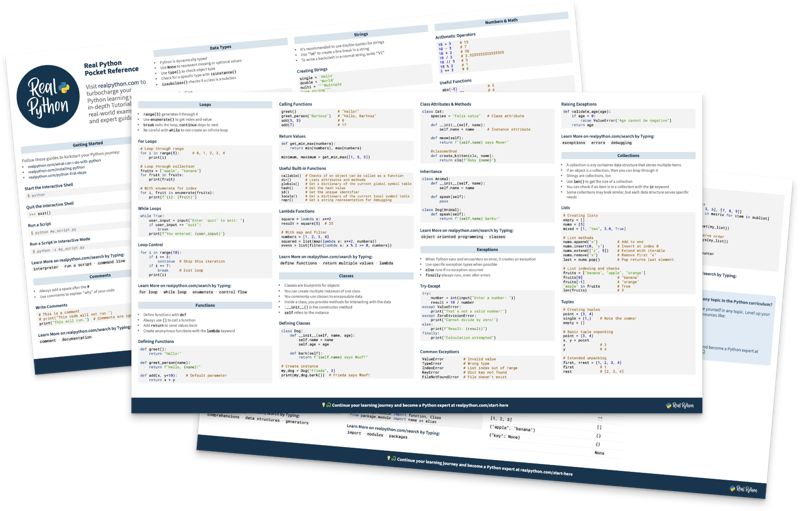
- Control flow:
if,elif,else,for,while,break,continue,pass. - Function and class definition:
defandclass. - Exception handling:
try,except,finally,raise. - Importing modules:
import,from,as. - Logical values:
True,False,None.
Understanding keywords helps you write syntactically correct Python and avoid naming conflicts.
Handling Exceptions
Exceptions are errors that occur during program execution. Python provides a robust exception-handling mechanism using try, except, else, and finally blocks. For example:
try:
    result = 10 / 0
except ZeroDivisionError:
    print("Cannot divide by zero")
finally:
    print("Execution completed")
Common built-in exceptions include ValueError, TypeError, IndexError, KeyError, and FileNotFoundError. Knowing when and how to catch exceptions improves code reliability and user experience.
Quiz Preparation Tips
Now that you've revisited these core concepts, you're ready to test your knowledge with the Revisit Python Fundamentals quiz. The 15 questions cover variables, data types, operators, expressions, keywords, and exceptions. Here are a few tips:
- Review each topic from this guide, especially areas where you feel uncertain.
- Practice writing small code snippets to reinforce understanding.
- Use Python's interactive interpreter to experiment with operators and exceptions.
- Take note of common pitfalls, like confusing
==(equality) with=(assignment).
Once you're comfortable, proceed to the next learning path with confidence.
Conclusion
Mastering Python fundamentals is the foundation of becoming a proficient programmer. By understanding variables, data types, operators, expressions, keywords, and exceptions, you equip yourself with the tools to write clear and efficient code. Ready to test yourself? Take the quiz and revisit any topics that need polishing. And for ongoing improvement, consider subscribing to Python Tricks – a short, sweet Python tip delivered to your inbox every couple of days. Click here to learn more and see examples.