Introduction
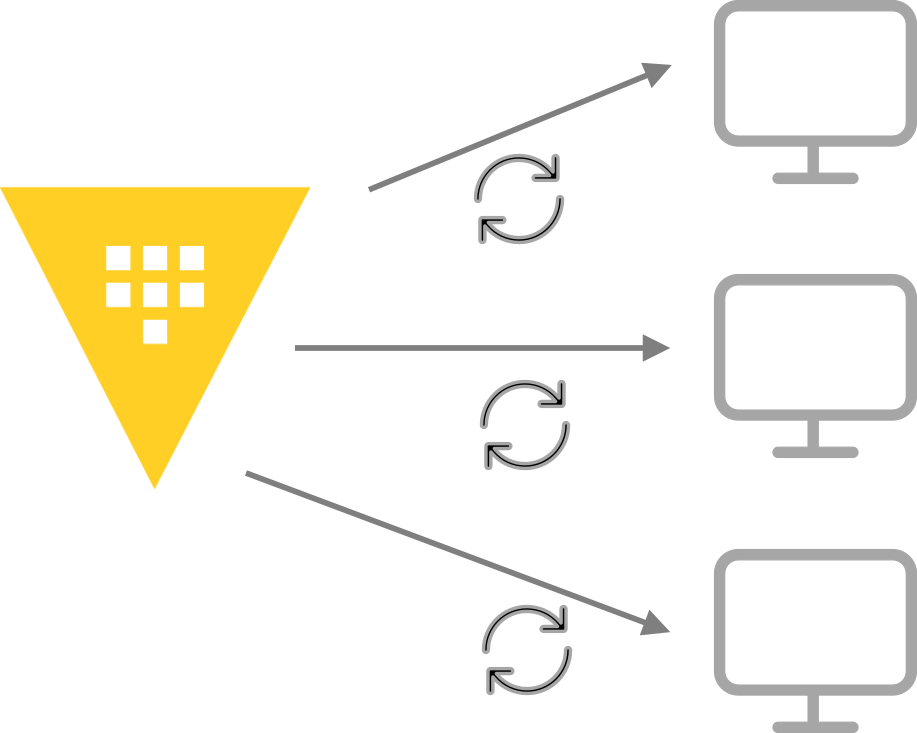
In today's enterprise security landscape, identity is the new perimeter. While many organizations have centralized identity management through LDAP, Active Directory, or cloud identity providers, a critical gap remains at the last mile: local operating system accounts. These often-forgotten accounts—like root or admin—can become unmanaged backdoors, risking lateral movement if a single credential is compromised. IBM Vault Enterprise 2.0 introduces a dedicated plugin for rotating local account passwords, bringing these unruly accounts under the same rigorous control and auditing as other secrets. This guide walks you through setting up and using the plugin to secure your local accounts.
What You Need
Before you begin, ensure you have the following:
- IBM Vault Enterprise 2.0 or later (with the local account password rotation plugin enabled).
- Access to target systems (e.g., Red Hat Enterprise Linux, Ubuntu, or other supported operating systems).
- SSH access to each target host (passwordless key-based authentication recommended).
- Administrative privileges on both Vault and the target systems.
- Vault CLI or Terraform provider for Vault (optional, for automation).
- Network connectivity between Vault server and target hosts (port 22 open for SSH).
Step-by-Step Guide
Step 1: Enable and Mount the Plugin
First, ensure the local account password rotation plugin is enabled in your Vault Enterprise cluster. Mount the plugin as a secrets engine:
- Log in to the Vault CLI or UI with sufficient permissions.
- Mount the plugin using the command:
vault secrets enable -path=local-accounts -plugin-name=local-account-rotate. - Verify the mount:
vault secrets list. You should see thelocal-accounts/path.
This creates a dedicated secret engine for managing local account rotations.
Step 2: Configure Target Hosts
For each target system, you need to configure a role that defines which local account to manage and how to connect.
- Create a role configuration file (JSON) specifying the SSH connection details:
{
  "allowed_roles": "*",
  "host": "192.168.1.100",
  "port": 22,
  "username": "root",
  "ssh_key": "@/path/to/private/key",
  "target_account": "root",
  "default_lease_ttl": "24h",
  "max_lease_ttl": "168h"
}- Write the role to Vault:
vault write local-accounts/roles/my-rhel-server @config.json. - Repeat for each target host, using unique role names (e.g.,
web-prod-01,db-backup).
Note: The plugin connects over SSH, which must be reachable from the Vault server. For best security, use key-based authentication and restrict the SSH key's permissions.
Step 3: Generate or Rotate a Password
Now, you can request a password for a specific host. This generates a unique, time-limited password and updates the local OS account.
- Read a password from the role:
vault read local-accounts/creds/my-rhel-server. - Vault returns a JSON response with the new password, username, and lease details. The password is automatically rotated on the target host.
- To trigger an on-demand rotation (even without reading credentials), use:
vault write -f local-accounts/rotate/my-rhel-server.
Each generated password is unique per host, eliminating the "common password" trap. The lease time (default 24h) ensures credentials expire automatically.
Step 4: Integrate with Your Workflow
You can automate rotations and integrate with existing tools:
- API calls: Use the Vault HTTP API to programmatically get or rotate passwords.
- CLI scripts: Wrap vault commands in cron jobs or CI/CD pipelines for periodic rotation.
- Terraform: Use the Vault provider to manage roles and rotations as Infrastructure as Code. Example resource:
resource "vault_generic_secret" "local_creds" { path = "local-accounts/creds/my-rhel-server" }
This allows you to enforce rotation policies consistently across all managed hosts.
Step 5: Audit and Monitor
Vault logs all access and rotations. To maintain visibility:
- Enable audit logging:
vault audit enable file file_path=/var/log/vault_audit.log. - Review logs for who accessed which local account and when.
- Set up alerts on failed rotation attempts or unexpected lease renewals.
This addresses the visibility deficit, giving you a clear audit trail of local account activity.
Tips for Success
- Start with a test host — Validate the plugin on a non-production system before rolling out to critical servers.
- Use short lease TTLs — Set default_lease_ttl to a few hours to minimize standing privileges.
- Rotate manually after incidents — Use the on-demand rotate command immediately if a credential is suspected compromised.
- Combine with dynamic secrets — For even stronger security, use local account rotation alongside database and cloud secret rotation.
- Document your roles — Maintain a mapping of role names to hostnames in your inventory.
- Secure the SSH key — The key used by Vault to connect to hosts should be stored in Vault itself (e.g., as a KV secret) and accessed only by the plugin.
By following this guide, you close the last-mile security gap, transforming local accounts from forgotten backdoors into managed, auditable secrets.